Is Slots Temple safe and licensed in the UK?
 Available in GB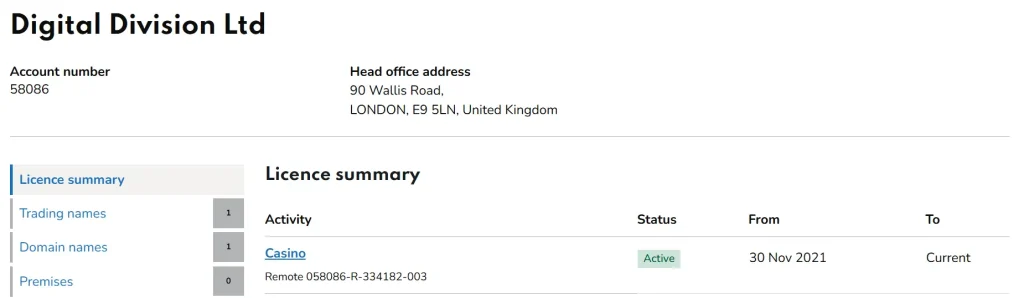
Licence check
Slots Temple is operated by Digital Division Limited, which appears in the Gambling Commission public register under account number 58086. That is the core regulatory fact UK players should verify before relying on review badges or marketing claims.
A valid Gambling Commission operator account establishes that the business is licensed within the Great Britain regulatory framework. It does not mean gambling is financially safe, that every complaint will be resolved in the player’s favour, or that every customer will have the same service experience. Licensing proves regulatory status, not guaranteed outcomes.
Table of Contents
- The verified operator behind Slots Temple
- What a Gambling Commission licence means in practice
- What the licence does not guarantee
- How to verify the licence yourself
- Responsible-gambling controls are part of the regulatory picture
- Support and complaints are different from licence verification
- User reviews are experience signals, not regulatory proof
- Why the operator name matters more than the casino badge
- Why licence status and service quality should be scored separately
- What the UKGC licence tells you about Slots Temple – and what it cannot promise
The verified operator behind Slots Temple
The public register lists Digital Division Ltd with Gambling Commission account number 58086. Slots Temple’s own UK pages identify Digital Division Limited in the site footer and use the same account number, linking the consumer-facing brand to the licensed operator.
That cross-check is stronger than relying on a casino review site. A review can tell you what an author thinks, but the regulator register is the authoritative source for whether the operator appears in the British licensing system.
If you are checking the account before registering, compare this licence information with the practical steps on the Slots Temple registration page.
What a Gambling Commission licence means in practice
Online casino operators serving consumers in Great Britain require the relevant Gambling Commission licence. Licence holders are subject to the Commission’s Licence Conditions and Codes of Practice and can face regulatory action if they breach those obligations.
For players, this means the operator is not simply presenting itself as a UK-facing casino without regulatory oversight. The business operates inside a framework covering areas such as age verification, anti-money-laundering controls, customer interaction, safer gambling and fair treatment.
Regulation also creates a traceable operator identity. That matters because a brand name can change, while the licensed legal entity and regulator account provide a more durable reference point.
What the licence does not guarantee
The word “licensed” should not be translated into “guaranteed safe”. Gambling always carries the possibility of financial loss, and a licence cannot make a losing product risk-free. It also cannot guarantee that every withdrawal will be instant or that every customer-service interaction will be satisfactory.
A licence does not promise a particular dispute outcome either. Regulators set rules and can investigate compliance, but individual complaints still depend on their facts, the operator’s procedures and any applicable dispute-resolution route.
This distinction is useful when comparing casinos. Regulatory legitimacy is a threshold question. Service quality, game preference, banking convenience and personal experience are separate questions that need their own evidence.
How to verify the licence yourself
Go to the Gambling Commission public register and search for Digital Division Ltd or account number 58086. The account number is the quickest identifier because company names can be easy to mistype.
Then compare the register details with the legal information shown on Slots Temple’s own site. A matching operator and account number is much stronger evidence than a logo saying “licensed” on an affiliate page.
For a real-world check, repeat the process before depositing if a long time has passed since you last used the site. Regulatory status can change, so current register evidence is more useful than an old screenshot or an archived review.
Responsible-gambling controls are part of the regulatory picture
Slots Temple provides daily, weekly and monthly net deposit limits and supports self-exclusion. The brand also references GamStop, the national multi-operator self-exclusion scheme used in Great Britain.
These features are relevant trust signals because they align with the broader UK regulatory environment, but they should not be treated as proof that a particular person can gamble safely. Controls help a customer manage access and spending; they do not remove the underlying risk of loss.
If you want to understand how limits and checks appear during account use, the registration and verification guide explains them in context.
Support and complaints are different from licence verification
Slots Temple publishes a support email, [email protected], and an official complaint process. That gives customers a documented first route when something goes wrong.
Support availability is useful, but it is not a substitute for regulation. A responsive support team does not prove licensing, and a slow support interaction does not automatically prove regulatory failure. The strongest way to assess legitimacy is still to verify the operator in the public register.
Banking questions also need to be judged on their own facts. See the Slots Temple payment methods for deposit and withdrawal details rather than inferring payment quality from the licence alone.
User reviews are experience signals, not regulatory proof
Player reviews can help identify recurring themes such as app usability, game preference or support responsiveness. They are much weaker evidence for the legal status of the operator because reviewers can be mistaken, anonymous or working from outdated information.
The same caution applies to review scores. A high rating does not replace a licence check, and a low rating does not by itself mean the operator is unlicensed. The register should answer the regulatory question; user reports can then add context about day-to-day experience.
This separation makes comparisons more useful. First establish whether the operator is legitimately licensed for Great Britain, then decide whether its product and service suit you.
Why the operator name matters more than the casino badge
Casino brands are consumer-facing names, while the regulator records the legal entity that actually holds the licence. That is why the name Digital Division Ltd matters. A player may remember the Slots Temple brand more easily, but the regulator account is attached to the company behind it.
This distinction helps when checking other pages too. If a review shows a licence badge but never identifies the operator, the evidence is incomplete. A useful verification trail should let you move from the brand name to the legal operator and then to the regulator record. Slots Temple’s own legal information and the Gambling Commission register provide that chain here.
It also prevents a common mistake: assuming that two sites with similar branding are automatically the same regulated business. The licence belongs to the named operator, not to a visual style, logo or marketing phrase.
Why licence status and service quality should be scored separately
A licence answers whether the operator is part of the regulated Great Britain market. It does not answer whether you will like the game catalogue, find the withdrawal process convenient or prefer the support experience. Those are product and service questions.
Keeping those categories separate makes a review more useful. A casino can be properly licensed and still have features you dislike. Equally, a slick interface or generous-looking promotion does not compensate for missing regulatory evidence. The sensible order is to verify legitimacy first, then assess the practical experience on its own merits.
What the UKGC licence tells you about Slots Temple – and what it cannot promise
The current evidence supports a clear conclusion: Slots Temple is connected to Digital Division Limited, and Digital Division Ltd appears in the Gambling Commission register under account number 58086. That establishes a verified Great Britain regulatory link.
What it cannot establish is that gambling will be profitable, that every payment will be frictionless, or that every dispute will have the outcome a player wants. Those are different questions and should not be smuggled into the meaning of “licensed”.
For UK readers, the licence is therefore a necessary trust check rather than a blanket endorsement. Use it as the starting point, then assess account controls, payments, games and support on their own evidence.